Industrial Knowledge Management: How to solve Data Silos & Brain Drain
Industrial Knowledge Management is no longer just a technical luxury—it is the survival strategy for modern manufacturing. Today, companies are facing a dual crisis: an exponential growth of internal data and a ticking clock on the specialized workforce that knows how to use it.
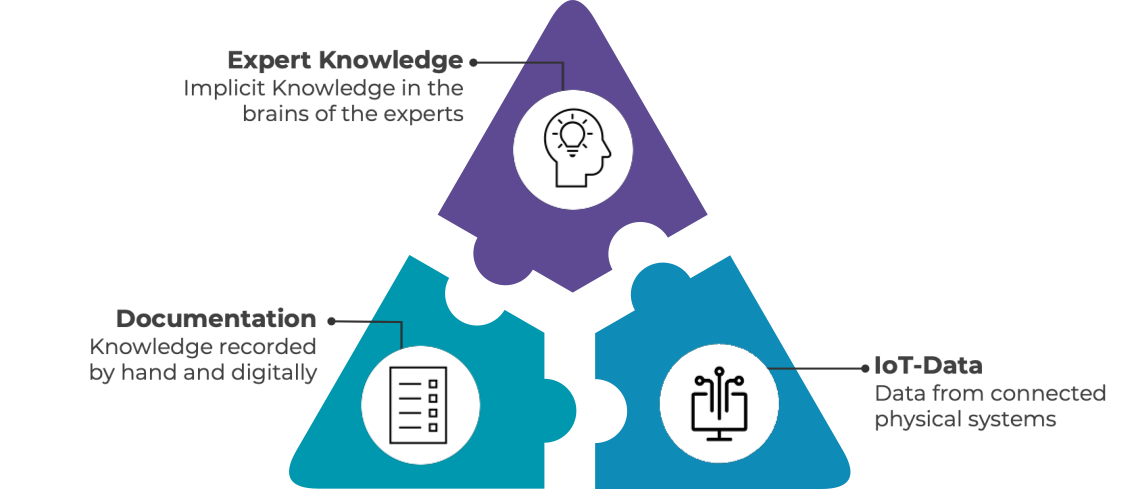
In our experience, enterprise knowledge is scattered across highly heterogeneous data sources—isolated silos that remain disconnected throughout the organization. This critical information lives buried in complex PDF documentation, nested deep within proprietary asset data, or—most precariously—trapped exclusively inside the minds of veteran employees.
The Hidden Cost of Inefficient Industrial Knowledge Management
When information remains fragmented, the financial and operational costs are staggering. Studies reveal a frustrating reality for modern enterprises: over 25% of working hours are wasted simply on information gathering. Instead of innovating, executing projects, or optimizing production lines, high-value engineers and technicians spend a quarter of their day digging through disconnected systems to find the insights they need to do their jobs.
As the volume of corporate documents and asset data continues to grow exponentially, locating relevant information is becoming increasingly difficult. This inefficiency directly caps a company’s ability to leverage its collective intelligence quickly and profitably. An effective approach to Industrial Knowledge Management reduces this “search tax” by creating a unified, intelligent foundation for all technical data.
The Demographic Shift: 13 Million Experts Are Retiring
While navigating the daily drag of data silos is a major hurdle, an even larger structural threat looms over the industrial landscape. By 2036, approximately 13 million people are expected to leave the German labor market due to retirement.
When these veteran employees walk out the door, decades of invaluable, unwritten expertise walk out with them. Companies simply cannot afford to lose this implicit knowledge. This impending generational shift creates an urgent, undeniable need for innovative, AI-driven Industrial Knowledge Management systems that secure institutional memory before it vanishes. By digitizing expert processes, we ensure that new generations can pick up where the experts left off, without a loss in quality or efficiency.
How Modern Technology Bridges the Gap
To overcome these challenges, we must rethink how we store, retrieve, and share information. Advanced Industrial Knowledge Management platforms now utilize Large Language Models (LLMs) and vector databases to turn static documents into interactive knowledge bases.
Imagine a system where a technician simply asks, “How did we resolve the pressure drop on this specific machine last year?” and receives an instant, accurate answer based on years of historical test reports and maintenance logs. This level of accessibility is the cornerstone of a competitive, future-proof manufacturing company.
Implementing Your Strategy
Transitioning to a robust Industrial Knowledge Management system requires more than just software—it requires a cultural shift. It means valuing documentation as much as production output. It involves training teams to update central data repositories rather than relying on local spreadsheets or memory. Ultimately, it is about creating a “single source of truth” that scales with your company.
Conclusion: Securing Your Future
The solution is not just better documentation, but the intelligent connection of data to the people who need it most. By implementing advanced worker assistance systems and language model integration, organizations can bridge the gap between their technical data and their workforce’s daily needs.
It is time to move from fragmented silos to a unified foundation of collective intelligence. Through strategic Industrial Knowledge Management, you can capture your institutional memory and stay ahead in an increasingly competitive market. Is your organization ready to transform its data into a competitive advantage?